
Appellate Briefs & Oral Arguments
Appellate Briefs
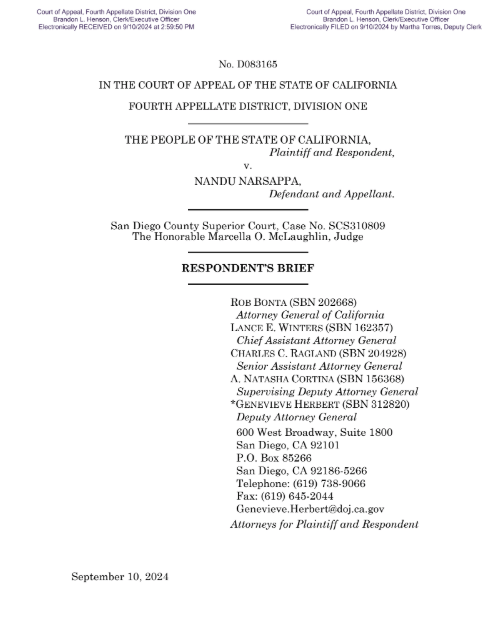
People v. Narsappa (SCS310809; D083165)
In my first appellate brief, People v. Narsappa, I defended a conviction for one count of forcible lewd act upon a child and five counts of lewd act upon a child. On appeal, the defendant challenged the forcible lewd act conviction, arguing there was insufficient evidence of force. I maintained that substantial evidence—including the victim’s testimony and contemporaneous messages she sent to a friend—demonstrated that the defendant used force beyond that necessary to commit the underlying lewd act. The case presented unique challenges due to the sensitive subject matter and inconsistencies in the victim’s testimony, but the record as a whole ultimately supported the trial court’s finding.
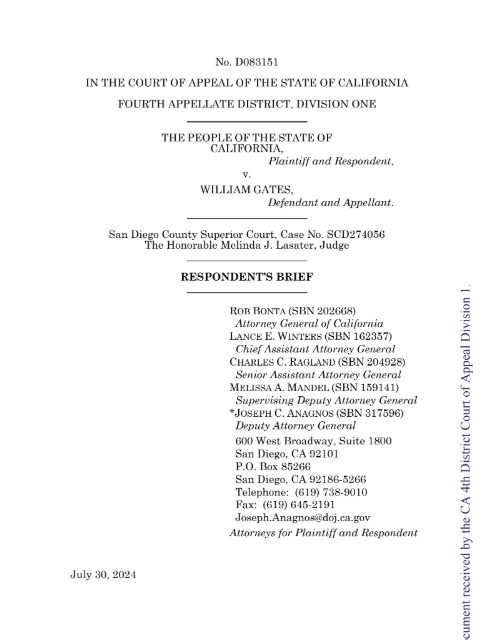
People v. Gates (SCD274056; D083151)
In my second appellate brief, People v. Gates, I defended convictions for assault with force likely to produce great bodily injury, battery with serious bodily injury, and gassing a peace officer. On appeal from resentencing, the defendant argued that Penal Code section 1385, subdivision (c)(2)(B) required dismissal of one of his two enhancements based on the statute’s “shall” language, and alternatively, that the trial court abused its discretion by applying an overly broad public safety standard. I responded that the claim was forfeited and, in any event, failed on the merits. Relying on statutory interpretation and legislative history, I argued that “shall” did not mandate dismissal under section 1385 and that the trial court properly exercised its discretion in finding dismissal would endanger public safety given the defendant’s extensive criminal history and pattern of unprovoked violence. This case was the most legally technical I had worked on to date, and it gave me valuable experience in analyzing legislative intent, constructing persuasive statutory arguments, and drafting complex procedural backgrounds.
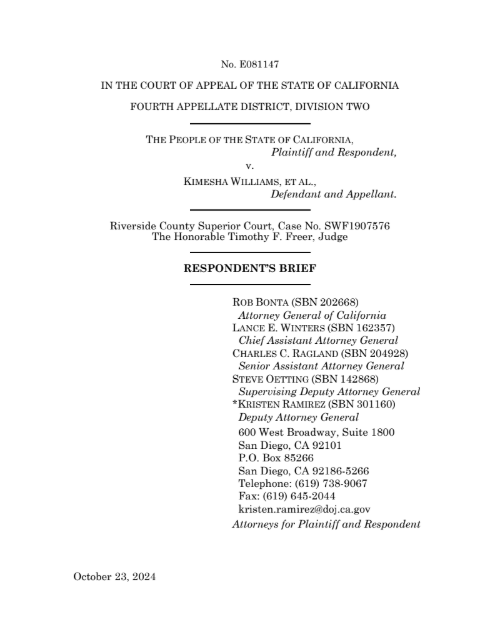
People v. Williams (SD2023802432; E081147)
In my third appellate brief, People v. Williams, I addressed a single issue in a multi-issue appeal arising from the felony murder of an elderly woman during a robbery in a casino restroom. The defendant was convicted of felony murder and felony elder abuse and sentenced to life without the possibility of parole. On appeal, she argued that the elder abuse conviction must be reversed because CALCRIM No. 830 allegedly permitted the jury to convict her under an invalid “permitting the victim to suffer” theory, despite no special relationship existing between her and the victim. I responded that the claim was forfeited by her failure to object to the instruction and, more substantively, that CALCRIM No. 830 was a correct statement of law. Reviewing over 2,100 pages of records, I demonstrated that the instructions, trial proceedings, and overall record made clear the jury convicted under a legally valid causation theory, not the “permission” theory. This case required intensive record review and precise statutory analysis, and it marked a turning point in my development as an advocate.
Oral Arguments
I gained valuable practical experience and genuine enjoyment in brief-writing, but oral argument was where I truly thrived. From my first moot court exercise through my initial appearance before the Fourth District Court of Appeals, I felt at home in appellate advocacy. I loved the challenge of thinking on my feet and responding to complex questions from the bench—so much so that I extended my internship to request a second appearance, ultimately becoming the only intern in my class to argue and win two cases. These experiences deepened my confidence as an advocate, sharpened my ability to distill complex records into clear oral arguments, and confirmed my passion for appellate practice. To view my arguments in full, click the Youtube links below.

Appearing before the Fourth District Court of Appeal, I defended a conviction for malicious animal cruelty in which appellant challenged the trial court’s admission of expert testimony from an Animal Services Officer. I argued that the trial court acted within its discretion in allowing the testimony, which demonstrated that injuries sustained by a dog under appellant’s care were too severe to be caused by accident. The officer’s extensive experience investigating hundreds of animal injury cases qualified her to assess whether the injuries matched appellant’s explanation. Furthermore, even if admitting the testimony had been in error, it was harmless in light of overwhelming evidence that the dog’s injuries resulted from severe blunt force trauma. During oral argument, I emphasized the deferential standard of review and addressed multiple complex questions regarding the scope of the officer’s expertise and the significance of competing expert opinions. The court affirmed the conviction, agreeing that the trial court had not abused its discretion, and even had it done so, the error would have been harmless. Though the tragic facts of this case made it particularly difficult to argue, the experience pushed me to hone my oral advocacy skills to a level that gave me genuine confidence in my ability to practice law.

Note: My portion of the argument begins at minute mark 03:05 and concludes at minute mark 10:26, between the appellant’s opening and rebuttal.
I delivered my first appellate oral argument before the Fourth District Court of Appeal in People v. Nazari, defending two felony insurance fraud convictions. At trial, appellant had been caught on surveillance repeatedly exaggerating his injuries to support a fraudulent claim worth nearly $100,000, while behaving normally when he believed no one was watching. On appeal, he argued that the evidence was insufficient, because the first surveillance session occurred ten days after the doctor’s appointment underlying both fraud charges, leaving open the possibility of a sudden recovery followed by a decision to fabricate symptoms. I responded by emphasizing appellant’s consistent pattern of deception and the medical implausibility of such a dramatic recovery without any change in treatment. During oral argument, the panel pressed me with pointed questions about the evidentiary gap, and I highlighted why the jury could reasonably infer that the fraud extended back to the appointment itself. Despite the lack of direct proof from that precise day, I successfully argued that the record as a whole provided substantial evidence to uphold both convictions.
Certificates & Specialized Training
Executive & Post-Graduate Certificates
University of California, Berkeley
This executive certification delivered hands-on training in generative AI for the legal field, with modules on professional responsibility and governance, prompt engineering, litigation research, argument building, and communication optimization. Participants gained practical experience applying AI tools to legal workflows while mastering risk mitigation strategies for hallucination, confidentiality, and bias to ethically navigate the future of law in an AI-driven era.
Purdue University
This rigorous post-graduate program provided real-world, end-to-end training in applied generative AI, covering Python coding, prompt engineering, large language model architecture, LangChain workflow design, image generation techniques, and AI governance. Through live instruction, intensive practical projects, and tools such as ChatGPT, DALL-E, Hugging Face, and Azure, participants gained extensive experience in building, fine-tuning, and ethically deploying AI applications across diverse contexts.
Professional Certificates
- Leveraging AI for Governance, Risk, & ComplianceProject Management Institute & LinkedIn
This professional certificate course examined the integration of AI into governance, risk, and compliance, with a focus on legal considerations, risk management, and ethical adoption. Participants analyzed GRC roles and responsibilities, evaluated benefits and limitations of AI solutions, and explored key factors in assessing AI program terms and conditions.
- Career Essentials in Generative AIMicrosoft & LinkedIn
This professional certificate delivered practical training in generative AI tools, with a focus on prompt engineering and applied productivity. Participants gained experience using Copilot, ChatGPT, and DALL-E to craft effective prompts, automate tasks, create presentations, and perform data analysis. The program emphasizes leveraging AI to enhance creativity, improve collaboration, and make smarter decisions in the evolving AI-driven workplace.
- Build Your Generative AI Productivity SkillsMicrosoft & LinkedIn
This professional certificate delivered practical training in generative AI tools, with a focus on prompt engineering and applied productivity. Participants gained experience using Copilot, ChatGPT, and DALL-E to craft effective prompts, automate tasks, create presentations, and perform data analysis. The program emphasizes leveraging AI to enhance creativity, improve collaboration, and make smarter decisions in the evolving AI-driven workplace.
- Microsoft CoPilot for ProductivityMicrosoft & LinkedIn
This professional certificate provided hands-on training in Microsoft 365 Copilot, equipping participants to integrate AI seamlessly into everyday workflows. The program covered using Copilot in Word, Excel, Outlook, PowerPoint, and Teams to streamline tasks, refine documents and presentations, and enhance collaboration. Emphasizing practical skills in prompt writing and workflow optimization, the course prepared professionals to work smarter, faster, and more effectively with AI-powered tools.
- Microsoft Azure AI EssentialsMicrosoft & LinkedIn
This professional certificate offered comprehensive training in AI fundamentals using Microsoft Azure, covering generative AI, machine learning, natural language processing, computer vision, and document intelligence. Through hands-on demos and applied exercises, participants learned to design and deploy AI workloads, evaluate responsible AI practices, and leverage Azure AI tools to drive business innovation. The program emphasized both technical proficiency and ethical implementation in real-world contexts.
- Career Essentials in GitHubMicrosoft & LinkedIn
This professional certificate equipped emerging developers with practical skills to strengthen their GitHub portfolios and enhance their competitiveness in the job market. Participants gained hands-on experience creating automations with GitHub Actions, applying AI-assisted development through Copilot, and practicing GitHub’s collaborative features on real projects. The program emphasized building industry-relevant experience to accelerate professional growth in software development.
- Career Essentials in GitHub CoPilotMicrosoft & LinkedIn
This professional certificate provided practical training in AI-assisted software development using GitHub Copilot. Participants learned to leverage Copilot’s pair programming and chat extensions to write, refactor, and optimize code, while maintaining ethical and professional standards. The program emphasized improving workflow efficiency, enhancing productivity, and responsibly integrating AI into real-world development practices.
- Intellectual Property Rights (IPR)Udemy
This intensive certification provided a comprehensive foundation in intellectual property rights, with training in patents, trademarks, copyrights, and industrial designs. Through applied modules on patentability assessment, filing procedures, claim construction, and technology transfer, participants learned how to identify, protect, and strategically manage intangible assets. Emphasizing both legal and business perspectives, the program equipped professionals to safeguard innovations, minimize infringement risks, and maximize the value of IP through effective management and commercialization.
This intensive certificate program provided a comprehensive foundation in intellectual property rights, with training in patents, trademarks, copyrights, and industrial designs. Through applied modules on patentability assessment, filing procedures, claim construction, and technology transfer, participants learned how to identify, protect, and strategically manage intangible assets. Emphasizing both legal and business perspectives, the program equipped professionals to safeguard innovations, minimize infringement risks, and maximize the value of IP through effective management and commercialization.
Microsoft and LinkedIn
This professional certificate provided applied training in generative AI, covering core concepts, ethical considerations, and real-world applications. Participants gained hands-on experience with Microsoft Copilot for workflow automation, learned to evaluate the risks and benefits of AI deployment, and developed effective strategies for leveraging reasoning engines in research and decision-making.
Microsoft and LinkedIn
This professional certificate offered comprehensive training in AI fundamentals using Microsoft Azure, covering generative AI, machine learning, natural language processing, computer vision, and document intelligence. Through hands-on demos and applied exercises, participants learned to design and deploy AI workloads, evaluate responsible AI practices, and leverage Azure AI tools to drive business innovation. The program emphasized both technical proficiency and ethical implementation in real-world contexts.
Microsoft and LinkedIn
This professional certificate provided practical training in AI-assisted software development using GitHub Copilot. Participants learned to leverage Copilot’s pair programming and chat extensions to write, refactor, and optimize code, while maintaining ethical and professional standards. The program emphasized improving workflow efficiency, enhancing productivity, and responsibly integrating AI into real-world development practices.
Microsoft and LinkedIn
This professional certificate delivered practical training in generative AI tools, with a focus on prompt engineering and applied productivity. Participants gained experience using Copilot, ChatGPT, and DALL-E to craft effective prompts, automate tasks, create presentations, and perform data analysis. The program emphasizes leveraging AI to enhance creativity, improve collaboration, and make smarter decisions in the evolving AI-driven workplace.
Microsoft and LinkedIn
This professional certificate provided hands-on training in Microsoft 365 Copilot, equipping participants to integrate AI seamlessly into everyday workflows. The program covered using Copilot in Word, Excel, Outlook, PowerPoint, and Teams to streamline tasks, refine documents and presentations, and enhance collaboration. Emphasizing practical skills in prompt writing and workflow optimization, the course prepared professionals to work smarter, faster, and more effectively with AI-powered tools.
Course Certificates
- Generative AI for BeginnersUdemy
This course provided an introduction to generative AI, covering core concepts such as large language models, embeddings, prompt engineering, and fine-tuning. Participants explored industry use cases, ethical considerations, and future trends, with hands-on experience building a chatbot to apply generative AI in practice.
- Prompt Engineering with ChatGPTLinkedIn Learning
This course offered a comprehensive guide to maximizing ChatGPT, with training in advanced prompt engineering techniques such as personas, task splitting, Socratic prompting, and multimodality. Participants also learned best practices for secure and professional use, including minimizing hallucinations, applying data controls, and prompting DALL-E 3 within ChatGPT.
- Microsoft CoPilot - The Art of Prompt WritingLinkedIn Learning
This course provided practical training in prompt-writing for Microsoft Copilot, demonstrating how to summarize meetings in Teams, edit documents in Word, manage email threads in Outlook, and streamline everyday tasks through effective conversational prompts.
- Introduction to Prompt Engineering for Generative AILinkedIn Learning
This course introduced the fundamentals of prompt engineering, with training in text and image generation using tools such as ChatGPT, Gemini, Copilot, Claude, DALL-E, and Midjourney. Participants explored model capabilities and limitations, API interactions, and advanced prompting techniques, while emphasizing ethical and responsible AI use.
- Introduction to Multimodal Prompting for Generative AILinkedIn Learning
This course provided an introduction to multimodal AI, exploring how systems like GPT-4 and Google Gemini integrate text, images, and other inputs to expand capabilities. Participants gained hands-on experience applying multimodality for business use cases and practiced advanced prompting techniques.
- How to Research & Write Using Generative AI ToolsLinkedIn Learning
This course introduced practical strategies for using ChatGPT and other AI chatbots to enhance research and writing through prompt engineering. Participants learned to summarize complex information, analyze writing styles, build personas, and generate structured content while applying best practices for effective and consistent AI-assisted writing.
- Copilot in Word - Create & Refine Documents with AILinkedIn Learning
This course provided training in using Microsoft Copilot in Word to create new documents, refine and rewrite text, distill complex materials, and generate supporting visuals. Participants practiced applying prompt techniques to enhance clarity, efficiency, and writing quality.
- Copilot in Powerpoint - From Prompt to PresentationLinkedIn Learning
This course offered practical training in using Microsoft Copilot in PowerPoint to generate, refine, and customize professional presentations. Participants learned to create slides from prompts or existing documents, enhance text and visuals, and streamline presentation design with AI assistance.
- Advanced Prompt Engineering TechniquesLinkedIn Learning
This course explored advanced prompting strategies, focusing on the design and application of Chain-of-Thought and Tree-of-Thought techniques. Participants learned how these approaches differ, when to apply them, and how they enhance reasoning and output quality in AI-powered applications.
- Enhancing Excel with Generative AI ToolsLinkedIn Learning
This course demonstrated how to integrate generative AI tools with Microsoft Excel to enhance data analysis, visualization, and troubleshooting. Participants practiced preparing data with Power Query and Markdown, generating synthetic datasets, and crafting prompts to create detailed visualizations and optimize Excel workflows.
- Prompt Engineering with GeminiLinkedIn Learning
This course introduced Google Gemini, highlighting its multimodal capabilities for tasks such as brainstorming, writing, web browsing, and planning. Participants learned advanced prompting techniques and practiced using Gemini to analyze images, generate visuals, and summarize YouTube videos.
- Introduction to Agentic AI: Getting Started with AutoGen StudioLinkedIn Learning
This course provided hands-on training in AutoGen Studio, covering the design and configuration of AI agents, development of agentic workflows, and integration of advanced tools for multiagent systems. It emphasized practical prototyping and offered a strong foundation for applying agentic AI in real-world contexts.
- Python for BeginnersUdemy
This course introduced the fundamentals of Python programming, with training in flow control, functions, and core computer science concepts. Participants gained practical experience coding in PyCharm through lectures, exercises, and programming challenges.
- Claude AI: The AI Assistant You’ll Actually UseUdemy
This course provided comprehensive training in Claude AI, covering prompt engineering, iterative and role prompting, and advanced techniques for problem-solving and content generation. Participants practiced using Claude for brainstorming, summarization, marketing, visualization, and game design while learning strategies to minimize hallucinations and apply generative AI responsibly in business and professional contexts.
- Git & GitHib for BeginnersUdemy
This course provided comprehensive training in version control systems, with hands-on practice using Git, GitHub, GitLab, and SVN. Participants learned Git fundamentals, repository setup, branching, merging, conflict resolution, and remote collaboration, while also exploring advanced workflows and key differences across multiple platforms.
- The Complete Git Guide: Understand & Master Git & GitHubUdemy
This course offered in-depth training in Git and GitHub, covering both internal repository structures and practical workflows. Participants learned to manage commits, branches, merges, rebasing, and pull requests, while also using tools like GitHub Desktop, SourceTree, and Visual Studio Code for both basic and advanced version control operations.
- The Complete Guide to Google Gemini with Gemini UltraUdemy
This course provided comprehensive training in Google Gemini, covering its LLM variants, multimodal prompting, and advanced model parameters. Participants gained hands-on experience with Generative AI Studio, Gemini Vision Pro, and app development using the Python and Node SDKs, while also learning to scale AI applications through Google’s Vertex AI platform.
- Interface of Artificial Intelligence & Intellectual PropertyUdemy
This course examined the intersection of artificial intelligence and intellectual property law, analyzing patent, copyright, and trade secret protections across US, EU, UK, and Indian jurisdictions. Participants explored issues of ownership, authorship, liability, and infringement for AI-related inventions, with case studies on gaming software, autonomous vehicles, and open-source licensing.
- Prompt Engineering Skills for Legal ProfessionalsUdemy
This course introduced prompt engineering for legal professionals, with training in crafting effective AI prompts for case research, drafting documents, and summarizing complex texts. Participants practiced legal-specific applications of generative AI, including chain-of-thought prompting, workflow automation, and strategic problem-solving to enhance efficiency and client service.
- Generative AI, Chat GPT, CoPilot, & AI Agents MasterclassUdemy
This course provided advanced training in generative AI and Microsoft Copilot for business applications, including workflow automation, financial analysis, and strategic planning. Participants learned to fine-tune custom GPT models, build AI agents, apply anomaly detection and forecasting techniques, and use AI tools for data visualization, supply chain evaluation, and market strategy optimization.
- AI Prompt Engineering Masterclass: Chat GPT, Claude, & GeminiUdemy
This course provided practical training in prompt engineering, with hands-on practice writing and refining prompts for ChatGPT, Claude, Gemini, and Grok. Participants learned to tailor prompts for professional tasks across industries, control tone and format, compare outputs across models, and apply AI effectively in daily workflows.
- LLM Mastery: Chat GPT, Gemini, Claude, Llama3, OpenAI, & APIsUdemy
This course provided comprehensive training in large language models, covering architectures, fine-tuning, reinforcement learning, and multimodal processing. Participants gained hands-on experience with prompt engineering, RAG, API integrations, and app development using ChatGPT, Gemini, Claude, Llama 3, and open-source models, while also exploring security, ethical considerations, and future trends in LLMs.
- Introduction to Legal Research & Writing Using AIUdemy
This course focused on enhancing legal research and writing through AI, combining traditional methods with advanced technologies. Participants practiced case law, statutory, and regulatory research while learning to apply AI tools for document analysis, information extraction, and drafting persuasive legal briefs and memoranda.
- AI Mastery for Legal Professionals: Transforming LawyersUdemy
This course provided applied training in AI for legal professionals, focusing on automating documentation, enhancing legal research, and applying predictive analytics for case strategy. Participants learned to integrate AI tools for efficiency, risk mitigation, and client engagement, gaining future-ready skills to innovate and lead in the evolving legal landscape.
- The Complete Agentic AI Engineering CourseUdemy
This course provided intensive, hands-on training in Agentic AI, with practical experience designing, building, and deploying autonomous AI agents. Participants mastered frameworks including OpenAI Agents SDK, CrewAI, LangGraph, Autogen, and MCP through eight real-world projects, from digital twins and sales agents to research teams and autonomous trading systems.
LinkedIn Learning
This course provided an introduction to generative AI, covering its core concepts, model types, and content creation capabilities. Participants explored natural language models, variational autoencoders for anomaly detection, and the ethical and strategic considerations leaders should implement when adopting AI.
LinkedIn Learning
This course introduced the fundamentals of prompt engineering, with training in text and image generation using tools such as ChatGPT, Gemini, Copilot, Claude, DALL-E, and Midjourney. Participants explored model capabilities and limitations, API interactions, and advanced prompting techniques, while emphasizing ethical and responsible AI use.
LinkedIn Learning
This course introduced practical strategies for using ChatGPT and other AI chatbots to enhance research and writing through prompt engineering. Participants learned to summarize complex information, analyze writing styles, build personas, and generate structured content while applying best practices for effective and consistent AI-assisted writing.
LinkedIn Learning
This course offered practical training in using Microsoft Copilot in PowerPoint to generate, refine, and customize professional presentations. Participants learned to create slides from prompts or existing documents, enhance text and visuals, and streamline presentation design with AI assistance.
LinkedIn Learning
This course demonstrated how to integrate generative AI tools with Microsoft Excel to enhance data analysis, visualization, and troubleshooting. Participants practiced preparing data with Power Query and Markdown, generating synthetic datasets, and crafting prompts to create detailed visualizations and optimize Excel workflows.
LinkedIn Learning
This course provided hands-on training in AutoGen Studio, covering the design and configuration of AI agents, development of agentic workflows, and integration of advanced tools for multiagent systems. It emphasized practical prototyping and offered a strong foundation for applying agentic AI in real-world contexts.
LinkedIn Learning
This course provided practical training in Microsoft Copilot, covering how to use chat-based AI tools to streamline workflows, perform searches, and generate ideas and text. Participants learned effective prompting techniques and practiced applying Copilot across Word, Excel, PowerPoint, and Outlook to boost productivity.
LinkedIn Learning
This course introduced the ethical risks and considerations of generative AI, providing a framework for responsible analysis and decision-making. Participants learned to prepare organizations for ethical AI adoption by aligning technology teams, leadership, and stakeholders while applying principles of responsible AI and customer-centered design.
Project Management Institute and LinkedIn Learning
This professional certificate course examined the integration of AI into governance, risk, and compliance, with a focus on legal considerations, risk management, and ethical adoption. Participants analyzed GRC roles and responsibilities, evaluated benefits and limitations of AI solutions, and explored key factors in assessing AI program terms and conditions.
Project Management Institute and LinkedIn Learning
This course explored how generative AI can boost workplace productivity by automating routine tasks, enhancing collaboration, and supporting smarter decision-making. Participants also learned practical strategies for reimagining workflows and developing a roadmap for continuous learning in an evolving AI landscape.
LinkedIn Learning
This course provided practical training in using Microsoft Copilot for Excel to automate data preparation, formula creation, and analysis. Participants learned to apply Copilot for profiling, visualization, and advanced insights, while exploring the evolving role of AI in business data analysis.
LinkedIn Learning
This course provided practical training in using Microsoft Copilot in Outlook to draft emails, compose professional replies, and summarize long threads. Participants explored prompt techniques to improve email quality, efficiency, and inbox management.
This course provided training in GitHub Extensions for Copilot Chat, covering how to install, manage, and integrate extensions to improve coding efficiency. Participants learned to navigate the GitHub Marketplace and apply extensions to streamline workflows and enhance developer productivity.
LinkedIn Learning
This course focused on using GitHub Copilot responsibly to generate, inspect, and test code while maintaining quality and security. Participants learned strategies to avoid bias, ensure clean and maintainable code, and implement testing practices, including security test plans, to stay in control of AI-assisted development.
This course provided an introduction to generative AI, covering core concepts such as large language models, embeddings, prompt engineering, and fine-tuning. Participants explored industry use cases, ethical considerations, and future trends, with hands-on experience building a chatbot to apply generative AI in practice.
LinkedIn Learning
This course provided practical training in prompt-writing for Microsoft Copilot, demonstrating how to summarize meetings in Teams, edit documents in Word, manage email threads in Outlook, and streamline everyday tasks through effective conversational prompts.
LinkedIn Learning
This course provided an introduction to multimodal AI, exploring how systems like GPT-4 and Google Gemini integrate text, images, and other inputs to expand capabilities. Participants gained hands-on experience applying multimodality for business use cases and practiced advanced prompting techniques.
LinkedIn Learning
This course provided training in using Microsoft Copilot in Word to create new documents, refine and rewrite text, distill complex materials, and generate supporting visuals. Participants practiced applying prompt techniques to enhance clarity, efficiency, and writing quality.
LinkedIn Learning
This course explored advanced prompting strategies, focusing on the design and application of Chain-of-Thought and Tree-of-Thought techniques. Participants learned how these approaches differ, when to apply them, and how they enhance reasoning and output quality in AI-powered applications.
LinkedIn Learning
This course introduced Google Gemini, highlighting its multimodal capabilities for tasks such as brainstorming, writing, web browsing, and planning. Participants learned advanced prompting techniques and practiced using Gemini to analyze images, generate visuals, and summarize YouTube videos.
LinkedIn Learning
This course introduced the fundamentals of generative AI-powered reasoning engines, highlighting how they differ from traditional search engines. Participants learned best practices in prompt engineering and search strategies to account for language, tone, and context when using tools like ChatGPT for information retrieval.
LinkedIn Learning
This course provided training in Microsoft 365 Copilot, demonstrating how to create and revise documents, generate summaries, and analyze data using natural language requests across Word, Excel, Outlook, PowerPoint, and Teams. Participants also explored Microsoft 365 Business Chat to securely query and manage information from calendars, messages, and files.
Project Management Institute and LinkedIn Learning
This professional certificate course introduced no-code techniques for building AI applications and custom GPTs, with training in advanced prompt engineering, knowledge base creation, and output personalization. Participants practiced chain-of-thought prompting, few-shot learning, user intent detection, and defenses against prompt injection to design secure, task-specific AI systems.
LinkedIn Learning
This course provided an introduction to artificial intelligence, covering the distinctions between predictive and generative AI, machine learning algorithms, neural networks, and foundation models. Participants explored core AI concepts, challenges in natural language processing, and the practical applications of intelligent systems in business and professional contexts.
This course introduced generative AI tools for creating text, images, video, and audio, while examining the ethical considerations and content challenges they raise for creative professionals. Participants explored both the opportunities and broader implications of integrating generative AI into creative work.
LinkedIn Learning
This course provided training in using Microsoft Copilot within Teams to generate summaries of meetings and chat conversations. Participants also learned to leverage Microsoft 365 Chat to query schedules, documents, and organizational data for improved productivity.
Purdue University and Simplilearn
This intensive Purdue University course combined live, interactive lectures with rigorous assessments, culminating in both a comprehensive final exam on Python fundamentals and a capstone project requiring the design, development, and execution of a complex Python program. Participants gained mastery of procedural and object-oriented programming, Jupyter Notebook, Python installation and IDE use, identifiers, comments, and indentation, as well as deep practice with data types, operators, string handling, loops, functions, and variable scope. The program emphasized not only technical fluency but also the ability to apply advanced programming concepts in real-world problem-solving.
Purdue University and Simplilearn
This program provided an in-depth exploration of the theoretical foundations and structural design of modern generative systems. Through a blend of conceptual analysis and applied learning, participants examined the core architectures driving today’s AI revolution—including Variational Autoencoders (VAEs), Generative Adversarial Networks (GANs), and Transformer-based Large Language Models (LLMs). The course offered detailed study of attention mechanisms and their role in enhancing model precision, contextual understanding, and creative output. Learners gained hands-on experience implementing VAEs for data generation and anomaly detection, and explored adversarial training dynamics central to GAN development. Emphasis was placed on architectural efficiency, interpretability, and scalability, equipping participants with both the technical fluency and analytical insight necessary to evaluate and construct high-performance generative AI systems.
Purdue University and Simplilearn
This advanced certification delivered a rigorous overview of generative artificial intelligence, emphasizing the architecture, functionality, and practical applications of ChatGPT and other large language models. The curriculum integrated conceptual foundations with hands-on exploration of prompt engineering techniques, explainable AI frameworks, and conversational design strategies. Participants examined the underlying mechanisms of generative AI, including model training, fine-tuning, and token-based inference, while analyzing real-world use cases across industries. Core modules addressed responsible AI governance, bias mitigation, and the ethical implications of model deployment. By course completion, participants demonstrated technical fluency in leveraging generative AI tools, optimizing prompt performance, and evaluating model outputs through both computational and interpretive lenses.
Purdue University and Simplilearn
This hands-on certification provided an intensive, practice-oriented study of modern large language model development and deployment. The course integrated advanced prompt engineering, LangChain workflow design, and fine-tuning methodologies to equip participants with end-to-end proficiency in constructing and optimizing AI-driven applications. Learners designed modular LangChain pipelines to orchestrate dynamic language generation processes, implemented fine-tuned models for domain-specific tasks, and benchmarked system performance using industry-standard evaluation metrics. Emphasis was placed on aligning technical precision with applied creativity, developing robust LLM applications for summarization, Q&A, translation, chatbots, and sentiment analysis. By completion, participants demonstrated advanced fluency in leveraging LLM frameworks to build, refine, and assess scalable generative AI systems capable of real-world performance and reliability.
LinkedIn Learning
This course provided training in using GitHub Copilot to support code refactoring, from small pull request adjustments to larger structural changes. Participants learned how to apply Copilot to clean up, improve, and rework code across different programming contexts while evaluating its fit for real-world development challenges.
LinkedIn Learning
This course offered a comprehensive guide to maximizing ChatGPT, with training in advanced prompt engineering techniques such as personas, task splitting, Socratic prompting, and multimodality. Participants also learned best practices for secure and professional use, including minimizing hallucinations, applying data controls, and prompting DALL-E 3 within ChatGPT.
Additional Skills
Legal Skills
Legal Research, Writing, & Analysis
- Legal Writing (Briefs, Motions, & Pleadings)
- Legal Research & Case Law Analysis
- Statutory & Regulatory Interpretation
- Legal Data Analytics & Reporting
- Evidence Review & Analysis
- Intellectual Property Rights Analysis
Advocacy & Oral Communication
- Appellate Advocacy
- Oral Argument Before Appellate Courts
- Public Speaking & Legal Presentations
- Negotiation & Settlement Strategy
- Client Interviewing & Relations
Litigation & Case Management
- Civil Litigation
- Criminal Law & Procedure
- Courtroom Procedures & Trial Preparation
- Litigation Support & Discovery (Including e-Discovery)
- Document Review & Production
- Case & Project Management (Including Multi-Party & Complex Litigation)
Compliance, Policy, & Risk Management
- Compliance & Risk Assessment
- Regulatory Filings & Legal Compliance Documentation
- Policy Analysis & Legislative Drafting
- Interdisciplinary Collaboration on Governance & Compliance Issues
Professional Competencies
- Written & Oral Communication
- Time Management & Prioritization
- Critical Thinking & Problem Solving
- Ethical Judgment & Professional Responsibility
- Attention to Detail
- Adaptability in High-Stakes Environments
Technical Skills
Legal Research & Case Management Tools
- Westlaw & Thomson Reuters CoCounsel
- LexisNexis & Lexis + AI
- Bloomberg Law
- PACER (Public Access to Court Electronic Records)
Productivity & Collaboration Platforms
- Microsoft Office Suite (Word, Excel, PowerPoint, & Outlook)
- Google Workspace (Drive, Docs, Sheets, & Slides)
- Adobe Acrobat
AI & Legal Technology Applications
- Leveraging AI for Governance, Risk, & Compliance
- AI Policy Analysis & Regulatory Compliance (GDPR, CCPA)
- Advanced Prompt Engineering
- Multimodal Prompting for Generative AI
- Artificial Intelligence Models (ChatGPT Pro, Gemini, Microsoft
- Copilot, GitHub Copilot, Microsoft Azure AI, Claude, LLaMA,
- Adobe AI, Notebook LM, & PLAUD)
- CaseText Parallel Search
Programming, Data, & Automation
- Excel Data Analytics
- Basic Python Coding
- Google Apps Script
- API Integration & Chatbot Development
- Git & GitHub
Research & Data Analysis
- Archival Library Research
- Data Analysis & Reporting (Excel & AI-Assisted Analytics)
- Policy Research Platforms (OAL & GovTrack)
Legislative & Policy Drafting
- Legislative Drafting Tools & Bill Formatting Software
- Regulatory Filings & Compliance Documentation